With the outbreak of WWII, the US military needed a vehicle that could handle the mud and jungle of the South Pacific islands as well as the cold weather and forests of Europe. The vehicle they chose became an icon of WWII: the Willys Jeep.
At the start of the war, the US military asked all of the car companies from around the country to produce a prototype vehicles. Our military would then test these vehicles and determine which was the best. The winning company would then be contracted to produce X amount of vehicles for our military to use. The test consisted of only one task: the vehicles had to drive through a mud/water pit and come out with no problem. Out of all of the vehicles tested, only one completed the test: the vehicle designed by American Bantam Motors. Though Bantam won the contract, but due to their small size, production was shared by other companies including Ford and, like the name would suggest, they Willys Motor company. The Willys name stuck because the Willys company tweaked Bantam's designs a bit, and this version became the favorite among soldiers.
The Willys Jeep was loved for one main reason: rugged simplicity. There wasn't much that could go wrong on the vehicle because there wasn't that much on it to begin with. It was just the chassis, motor, a body, and four wheels- it didn't even come standard with a roof! Because the Jeep was light and featured 4-wheel drive, it did not get stuck in mud or muck very easily. The main drawback to the Jeep was its lack of a roof and adequate windshield, which left anyone inside exposed. Some stories have been told about Nazi soldiers stringing piano wire between trees on roads, which would decapitate the driver of the Jeep if he was going too fast. Despite its problems, the Jeep was loved by all American soldiers and the soldiers of countries that we sold Jeeps to. General Eisenhower even put the Jeep on his list of top 5 things that helped us win the war, which included the M1 Garand rifle, the M9A1 Bazooka antitank weapon, and the C-74 transport plane.
Thursday, March 8, 2012

Wednesday, January 18, 2012
1920s Autos
The car was a hot commodity during the 1920s. The legendary Ford Model T was quick to produce and in turn inexpensive for the consumer. This, along with the new concept of buying expensive items on credit and paying over time, made it easier than ever for average Americans to own a car. An assembly line worker could afford a car with just 4 months' pay.
As cars became more and more popular, lots of infrastructure had to be reworked. Roads that were originally designed to handle horse traffic quickly deteriorated with increased used by cars. Funding from the local, state, and federal levels helped to overhaul the road system so that they could withstand used by cars.

In my opinion, the 1920s were an important part of automobile history. Early in the decade, there were countless car companies in the US and abroad. As strong companies found their niches in the market, weaker companies began to go out of business. Many of the companies that were left are still around today, including Ford, GM (and its respective sub-brands such as Chevrolet and Buick), and Mercedes-Benz.
The included picture is a 1927 Chevrolet advertisement.
Source: http://www.1920-30.com/automobiles/
Picture: http://www.philseed.com/files/images/chevrolet-1927.jpg
As cars became more and more popular, lots of infrastructure had to be reworked. Roads that were originally designed to handle horse traffic quickly deteriorated with increased used by cars. Funding from the local, state, and federal levels helped to overhaul the road system so that they could withstand used by cars.

In my opinion, the 1920s were an important part of automobile history. Early in the decade, there were countless car companies in the US and abroad. As strong companies found their niches in the market, weaker companies began to go out of business. Many of the companies that were left are still around today, including Ford, GM (and its respective sub-brands such as Chevrolet and Buick), and Mercedes-Benz.
The included picture is a 1927 Chevrolet advertisement.
Source: http://www.1920-30.com/automobiles/
Picture: http://www.philseed.com/files/images/chevrolet-1927.jpg
Thursday, October 20, 2011
Early Automobiles in the USA
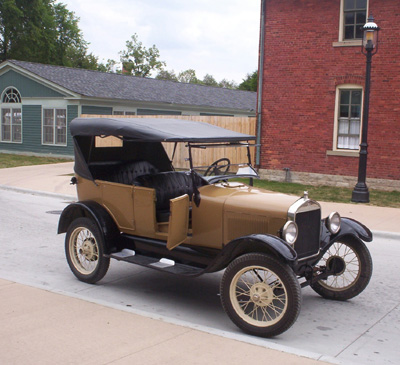
Seen here is a Ford Model T from 1927.

It is a common misconception that Henry Ford developed the assembly line process, based on Eli Whitney's interchangeable parts concept. However, Ransom Olds, the founder of the now extinct auto brand Oldsmobile, was the first person to adopt the assembly line process. The Ford motor company did develop the famous Model T, which is viewed as the first affordable American automobile. The average assembly line worker of the era could afford a Model T on just four months' pay. The assembly line production method was so successful that by 1930, nearly 250 companies who had not adopted this process went out of business. As smaller companies began to go bankrupt, they were swallowed up by larger companies. The Ford motor company purchased the Lincoln brand, and General Motors ended up with Chevrolet, Buick, and Oldsmobile, to name a few. I think that these initial expansions of large companies lead to the development of the oligopoly we have today. Although cars that are made throughout the world can be purchased in the US, the largest remaining American companies are GM, Ford, and Chrysler, who also market their respective sub-brands.
Sources:
http://en.wikipedia.org/wiki/Automobile
http://en.wikipedia.org/wiki/Buick
http://en.wikipedia.org/wiki/Ford_Motor_Company
http://en.wikipedia.org/wiki/General_Motors
And for your entertainment, I leave you with this clip. This is one of my favorite segments from BBC's Top Gear- currently the most watched show in the world. In this episode, the guys attempt to modify cars into "boats" and attempt to sail across a reservoir. Enjoy!
It is a common misconception that Henry Ford developed the assembly line process, based on Eli Whitney's interchangeable parts concept. However, Ransom Olds, the founder of the now extinct auto brand Oldsmobile, was the first person to adopt the assembly line process. The Ford motor company did develop the famous Model T, which is viewed as the first affordable American automobile. The average assembly line worker of the era could afford a Model T on just four months' pay. The assembly line production method was so successful that by 1930, nearly 250 companies who had not adopted this process went out of business. As smaller companies began to go bankrupt, they were swallowed up by larger companies. The Ford motor company purchased the Lincoln brand, and General Motors ended up with Chevrolet, Buick, and Oldsmobile, to name a few. I think that these initial expansions of large companies lead to the development of the oligopoly we have today. Although cars that are made throughout the world can be purchased in the US, the largest remaining American companies are GM, Ford, and Chrysler, who also market their respective sub-brands.
Sources:
http://en.wikipedia.org/wiki/Automobile
http://en.wikipedia.org/wiki/Buick
http://en.wikipedia.org/wiki/Ford_Motor_Company
http://en.wikipedia.org/wiki/General_Motors
And for your entertainment, I leave you with this clip. This is one of my favorite segments from BBC's Top Gear- currently the most watched show in the world. In this episode, the guys attempt to modify cars into "boats" and attempt to sail across a reservoir. Enjoy!
Thursday, September 15, 2011
The Early Automobile
The first demonstration of the internal combustion engine was produced by Nikolaus Otto in 1876. This self contained source of power became the method of choice for automobile makers. Seen below is a model of an early engine.

The modern automobile was invented by Karl Benz in 1885, in Germany. Although steam powered vehicles had been introduced roughly a decade prior, the automobile as we know it, which utilizes a 4-stroke, gasoline powered, cylinder-and-crankshaft, internal combustion engine, was the brainchild of Benz. His company, Benz & Cie, became the largest automobile producer at the time, producing over 500 vehicles in the year of 1899. A competing company, DMG, produced automobiles in smaller numbers for several years before merging with Benz's company shortly after WW1. The new company was dubbed Mercedes-Benz, which bears the name of DMG's Mercedes motor. Another important development of the era was the diesel engine, which was invented in 1892 by Rudolf Diesel. The diesel engine is slightly different, it does not utilize spark plugs to ignite the fuel, but rather the heat of the previous combustion to create ignition. These engines also use diesel fuel, which offers better efficiency and does not pollute the atmosphere as much as traditional gasoline does.
Check out this link for a cool animation of the 4-stroke internal combustion engine. There is some additional information below the animation.
http://www.animatedengines.com/otto.shtml
Sources: The link above, and my brain.
Picture courtesy of: http://bancroft.berkeley.edu/Exhibits/physics/images/origins18.jpg
Welcome!
Hello everyone, welcome to my blog. This blog will be all about cars and car technology developments throughout the years. Car designs and developments have fascinated me for quite some time. I intend to share my knowledge with you through this blog. If you want to learn about engines, aerodynamics, power, torque, and everything in between while having some laughs along the way, keep checking back here for updated posts on everything car related.
In the meantime, enjoy one of my favorite videos. This is one of the few Japanese cars I would actually buy.
Top Gear USA - Mitsubishi Evo X by cjrobe0
Credit for this video goes to Top Gear, a show on the History Channel. The driver's name is Tanner Foust. He is a professional driver and racer. Don't try this at home kids.
In the meantime, enjoy one of my favorite videos. This is one of the few Japanese cars I would actually buy.
Top Gear USA - Mitsubishi Evo X by cjrobe0
Credit for this video goes to Top Gear, a show on the History Channel. The driver's name is Tanner Foust. He is a professional driver and racer. Don't try this at home kids.
Subscribe to:
Posts (Atom)